
Writer of the Year Portfolio
Kathryn Winters · Scot Scoop · Carlmont High School
Personal Statement
There’s a certain look people get when you bring up California, one that indicates assumptions are already forming. For a long time, I always thought they were thinking about the obvious things: our wealth, technology, schools, Hollywood, or good weather — something material.
It wasn’t until I became a journalist that I realized the real privilege of living here is nothing material at all. It’s our ability to start change.
As I wrote for my school paper this past year, I began noticing how often the issues I covered divided the country, right along state lines. Colored maps of these divisions soon became common in my articles. And whether I was writing about healthcare, security, climate change, or artificial intelligence, California almost always stood out in shade. Not because we’re perfect, but because people here were willing to start the conversation.
Nearly every person I’ve interviewed has shared a perspective demanding change: firefighters who’ve watched flames wash away buildings and want more awareness, friends who’ve seen the secret struggle of living with color vision deficiency and want inclusion, doctors who’ve watched science become politicized and want a voice again, and, most recently, parents who’ve learned their children’s teachers are unable to afford cancer treatment and want equality.
It was that last story that reminded me of my purpose as a journalist.
—
Her name is Erika Feresten, and she is one of the most uncompromising people I’ve ever interviewed. For over an hour, she tore apart and dismantled every counterargument I presented against universal healthcare with no hesitation and absolutely no softening of her words.
At first, I was intimidated, having found many of those counterarguments reasonable myself after interviewing the opposing side, and so, I’ll admit, I was afraid. After all, I’d never felt yelled at in an interview. But in the hours after, as I replayed her thousands of sharp and even accusatory words, I realized I was embarrassed instead.
Until that interview, I had somehow lived in the middle of one of California’s, and what could even become one of our country’s, biggest healthcare debates without ever truly seeing it. It wasn’t until both of my parents lost their jobs — the curse of living in Silicon Valley during the AI boom — and suddenly, without employer-provided insurance, our own access to healthcare became uncertain that I sought the resources that led me to this story.
For the first time, I was writing for an issue that was truly personal to me, sharing the same thoughts of those affected: Was it even worth going to the doctor or getting a treatment? Could I even go?
Reporting it forced me to confront how many people quietly live with that uncertainty every day, and not just temporarily, but constantly. While single-payer coverage over private insurance might slow treatment for some, as Feresten argued, are we willing to completely sacrifice the health of others for that speed?
I became grateful for her intensity because, while I hadn’t even considered facing that issue, she had been leading this movement for decades, willing to speak loudly on behalf of others, a group I now fall into, with the hope that someone might hear and carry her words further, as I now have.
Being affected by the same insecurity as the people I was covering made me realize that Feresten and so many others around me already have powerful voices demanding change. I just hadn’t heard them before because what they need is someone willing to listen closely and carry their voices further. I’ve loved becoming that microphone.
Nothing gets me more fired up than hearing the passion and conviction of someone determined to make things better. When I write an article, it’s not just me speaking, but the voices of all those who’ve trusted me with their stories. I spend hours before the sun is up combing through transcripts and research because I want to give those calls for change the best shot they’ve got. There are people counting on them.
I’m privileged to grow up in a place where people feel empowered to challenge the system, so I have a responsibility to use that privilege well. Journalism has taught me how to do that. It’s taught me that change can’t happen alone, so I need to listen carefully and amplify the voices around me, whether they’re shouting, crying, or hiding. I hope to continue to do that as I keep writing, and inspire those around me to do the same as Editor-in-Chief.
Thank you,
.png)
Works
The following five pieces represent my most influential writing from the 2025-26 school year.
01: Feature

Debating healthcare as a human right
When CalCare, a proposed state-run universal healthcare system, failed to advance for the third time amid the same political and financial arguments it had become all too familiar with, the future of single-payer coverage in California looked bleak at best.
With my editor’s approval, I immediately jumped on the story, expecting to write about the pain and consequences of such a bill failing yet again for the many uninsured residents in our state. The effort had been going on for decades, after all.
Yet the first source I spoke with, Dr. Anthony DiGiorgio, gave me the exact opposite perspective. I logged onto our Zoom meeting carrying assumptions that quickly fell apart as soon as he told me he’d be giving an anti-view. In the moments following his remark, I was shocked. It seemed unethical to argue against a system designed to provide everyone with healthcare.
But DiGiorgio held true to his word. He walked me through what he believed would happen if the bill passed. Yes, everyone would be covered, but government-funded medical programs are already known for long wait times and limited access, issues he argued would only worsen under a statewide system like this. Working at a safety net hospital himself, he described the stark differences he saw between Medicaid patients and those with private insurance, an increase in delays that was often years long.
After finishing my interview with DiGiorgio, I felt confident I understood the issue. My next source, though less strongly worded, largely reinforced many of his same concerns.
Then came my final source: Erika Feresten, a mother who became involved in the movement after watching her son’s teacher have to launch a GoFundMe to afford cancer treatment. Her perspective reignited the ethical argument I had originally carried into the story. Would we really deny someone life-saving treatment so that our own care wouldn’t slow down?
Suddenly, I found myself balancing two deeply conflicting viewpoints, each from real experiences and genuine concern for people.
This was a new challenge for me. I had never covered an issue where sources disagreed so fundamentally with one another. Admittedly, living in California, many of the stories I’d previously reported involved the state positioning itself against national trends, so my interviews often leaned in a similar direction: with the state. But this time, the debate existed entirely within our borders.
I spent hours laying out transcripts side by side, comparing arguments and searching for places where the perspectives intersected. I worked carefully to ensure each side was represented fairly, resisting the temptation to lean too heavily toward the viewpoint I’d personally agreed with at the start or the one I now held a better understanding of. It was a struggle finding a structure that allowed both arguments to stand on their own without simply turning the article into a sequence of rebuttals that could unintentionally suggest a bias.
Both Feresten and DiGiorgio had given me their personal phone numbers for follow-up questions, and I relied on them extensively to fill gaps in my understanding and make sure I fully grasped the scope of their arguments.
Writing this article marked a turning point in my growth as a writer, forcing me to think more carefully about balance and nuance. More importantly, as a person, it taught me how to sit with perspectives I disagreed with, understand why people held them, and still share them with honesty and compassion.
Recognition received:
02: News
Night of Holiday Lights shines a seasonal shopping spotlight on local businesses

If you lived in San Carlos a couple years ago, you’d know that Laurel Street is where everything is at: arts and crafts, fun eats, and niche storefronts to explore. But as mainstream chain stores and online shopping have expanded in recent years, foot traffic in these downtown areas have slowed.
So when Night of Holiday Lights, one of the most beloved annual traditions of my hometown on that street, came around again, I saw a chance to give voice to the small businesses that I’ve seen become increasingly overshadowed. After speaking with just the first of these businesses that night, I knew this event held exactly the kind of story I wanted to tell for them.
Lauren Burd, who’s seen the celebration grow as both a longtime resident and now the recreation supervisor, told me the night’s true purpose in words: not just festivities, lights, and entertainment, but a deliberate effort to spotlight the exact small businesses and local restaurants I’d come to write for.
But it was as I walked the streets that evening, stepping into storefronts and pausing at pop-up booths, that I truly understood that purpose. Business owners, whether permanent fixtures on Laurel Street or vendors visiting for the night, shared how much events like these meant for them, drawing crowds, building recognition, and offering visibility they often struggled to find elsewhere. As the trees and streets lit up for the first time of the season, so did the businesses alongside them.
Through telling their stories, I hoped to show why nights like this matter, keeping the community coming back every year. They’re not just traditions, but reminders to keep supporting those close to home.
03: News
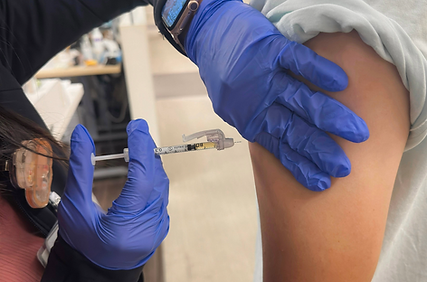
West Coast states break with CDC on guidelines
Shots are something I've always dreaded, and I think a lot of people can relate to that. However, I've always understood the value of them, considering myself lucky to be able to get them and stay healthy afterward. They were a choice: you could get them, but you didn’t have to.
But when the 2025 respiratory virus season brought news that I might not qualify for some of the same shots I’d been getting for the past 17 years, I was in shock. My choice had been taken away. A few clicks led me to the source of the shift: new federal vaccine guidance shaped under Health and Human Services Secretary Robert F. Kennedy Jr., a well-known anti-vaccine activist.
In the past, I’d tried to avoid covering political issues, worrying about controversy or stepping into debates that felt distant from me. But this time, politics wasn’t something distant; the repercussions of these decisions had reached my community. Someone needed to call them out.
As I began to sort through pages and pages of press releases, statements, and bills, this being my first real experience engaging with this level of policy documentation, I started to understand why so little attention had been paid to the issue before it directly reached my area: it was incredibly difficult to follow what was actually happening. In every document I skimmed, the language was dense with acronyms, agency names, and policy references.
It became clear to me that if people were going to understand what was changing, and why it mattered, it couldn’t stay buried in jargon. No one was going to fight for it if they couldn’t understand it.
That realization changed how I approached the rest of my reporting. I spent extra hours going back through sources, searching not just for facts to cite but for context: explanations, examples, and anecdotes that could help translate what I was reading into something clearer and more accessible. My goal in writing this piece wasn’t just to cover it, but to make it understandable enough that more people could actually engage with it.
Recognition received:
04: Feature
Editing humanity: A double-edged sword
.jpeg)
My grandfather was recently diagnosed with Parkinson’s disease. Growing up, I was always told stories about how he could fix anything, whether it was the machines at his laundromat or the furnace in his home. My parents described what he could do with his hands like it was magic.
But after he and my grandmother retired to California, I saw how much he had changed. Some afternoons, I’d come home from school to find him still asleep, and when he did wake up, even walking a few steps or holding his fork steady enough to eat lunch had become a struggle. A man who had once repaired everything suddenly couldn’t fix what was happening to him.
Seeing that difficulty in someone who’d always been so capable made me realize how deeply I wanted to help people facing similar challenges, so I began my research. One of the first results I encountered was CRISPR, a gene-editing technology that could potentially remove the genetic mutation causing many cases of Parkinson’s.
This curiosity soon led to a summer at the University of California, Berkeley, where I was able to study the technology and what it could one day do for people like my grandfather. There, I met Phoebe Hall, a Ph.D. student who not only taught me everything I know about the technology, but warned me of the ethical questions that must be answered before it could be used in such promising ways. While optimistic, she worried about how quickly scientific innovation could outpace public understanding and federal regulation.
And as our conversations continued, I began to see those concerns. I realized that this story was not simply about the scientific breakthrough I hoped for, but about addressing the responsibility that comes with such powerful technology: who gets to decide how far it should go, who benefits from it, and how and when repercussions are dealt. Those questions, and Hall’s urgency in raising them, ultimately inspired me to turn our lessons into this piece.
Writing it showed me how important it is for scientists to remain part of discussions about their work, in legislation and broader discourse. We live in a time when science has become increasingly politicized and, as a result, often misunderstood, causing a gap from the general public that Hall frequently referenced. Through my writing, I hoped to help bridge that divide by giving more visibility to the voices of researchers speaking not only about what their science can do, but about what society should allow it to do.
Recognition received:
05: Campus

Scotsland lets seniors leave one last mark
Every year, another class graduates. There are tears, goodbyes, and promises to keep in touch.
Facing these moments in the coming days, I knew I wanted to write one last article: an ode to the Class of 2026, many of whom taught and supported me throughout my three years at Carlmont.
With those memories in mind, I didn’t just want to write about their leaving; I wanted to show its impact. Since freshman orientation, the chaos and excitement of my first clubs fair showed me the importance of small communities to our culture. I was amazed by how many students showed up, and continued showing up, for one another at these events, whether to perform, organize, fundraise, or simply be there.
Scotsland, an annual tradition and the final fair of the year, felt like the culmination of that spirit: the final chance for seniors to showcase their four years of hard work. So instead of focusing only on the attractions and festivities, I approached this story through the people behind them and the communities they were preparing to pass on.
Every senior I interviewed spoke not just about their clubs, but about belonging. Again and again, I heard variations of the same sentiment: “I couldn’t imagine my high school life without it.” Writing this piece made it clear to me how much of high school is shaped by these smaller spaces and traditions that are often overlooked.
Yet many of the seniors I interviewed described having to push themselves into unfamiliar or uncomfortable spaces before finding those communities. Through their reflections, I hoped to encourage other students to take that same leap by showing how these groups can eventually become their second homes.